Old Corrugated Roof Replacement Wellington
Asbestos Checks, Safe Access and a Complete Re-Roofing Quote
Home / Roofing Guides and Projects / Old Corrugated Roof Replacement in Wellington: What to Check Before Re-Roofing


By the Metal Roofing Solutions team
Published 9 July 2026 · Wellington re-roofing guide and project example
If an older corrugated roof is weathered, leaking or reaching the point where repairs are becoming frequent, the next step is a proper roof assessment—not another guess from the ground. The existing sheet material, roof condition, access, junctions and any asbestos risk all need to be understood before a reliable replacement quote can be prepared.
The photographs on this page show a genuine Wellington re-roof completed by our team. They record the ageing corrugated roof before work and the finished silver long-run metal roof. A photograph cannot confirm whether the original material contains asbestos. Testing may therefore be needed before removal is priced, and the roofing quote should set out the work it actually covers.
| Project type | Replacement of ageing corrugated roof areas |
|---|---|
| Setting | Wellington property with several connected roof planes |
| Before | Weathered corrugated sheet roofing with visible staining and previous junction details |
| After | Silver long-run profiled-metal roofing with new flashings |
| Visible access | Perimeter scaffolding and working platforms |
| Important limitation | The photographs do not confirm the composition of the original sheets |
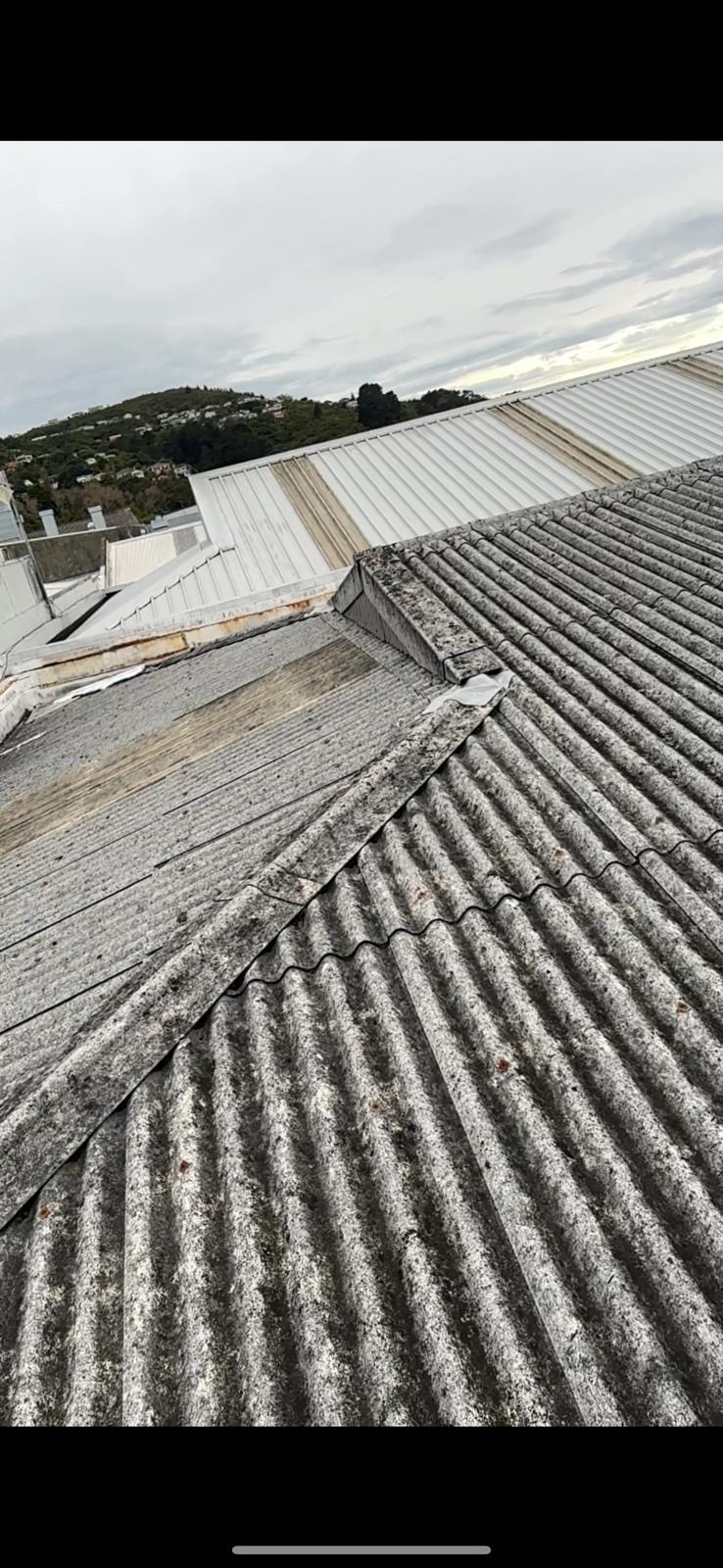
The before photograph shows extensive surface weathering across the foreground roof, along with staining on other corrugated sheets and several transitions between roof areas. That is useful information for planning an inspection, but it is not enough to diagnose every defect or identify the roofing material.
When we assess an older roof, we look beyond the most obvious sheet. The valleys, ridges, edges, fasteners, penetrations, gutters and changes between adjoining roofs can be just as important as the main covering. We also need to consider whether the sheets remain safe to access. WorkSafe notes that roofing can become brittle through its material, age or weathering, and that no one should access a brittle roof until suitable controls are in place.
For homeowners, the safest first inspection is from ground level. Do not climb onto a weathered roof to obtain a closer photograph or sample.
Possibly—but appearance is not proof. WorkSafe’s asbestos guidance for homeowners says materials containing asbestos can look identical to materials that do not, and the only way to confirm asbestos is through proper sample testing. WorkSafe also identifies asbestos cement roof sheeting and ridge capping as materials found in some older New Zealand buildings.
If asbestos is suspected, treat the material cautiously until it has been assessed. Do not drill, cut, sand, scrape or water-blast it. Those actions can disturb the surface and release fibres if asbestos is present. Sampling should be arranged through a reputable asbestos contractor rather than attempted as a DIY job.
The roofing photograph on this page has not been used to diagnose asbestos. A laboratory result or suitable asbestos survey is what should inform the removal plan and quotation.
A positive result changes how the existing roof is handled; it does not prevent the building from receiving a new metal roof. The removal scope should be based on the material type, condition, quantity and site access. It should identify the appropriately qualified asbestos contractor, controls for people nearby, removal and disposal arrangements, clearance requirements where applicable, and how the building will be kept protected while the new roof is installed.
The roofing and removal scopes need to connect. A quote that covers only the new sheets but leaves testing, removal, temporary weather protection or disposal unclear is not yet a complete project price. If you already have a laboratory or survey report, include it with your roofing enquiry so it can be considered from the start.
There is no useful fixed price based on the photograph alone. These are the main items we would expect a property-specific quote to consider:
A low initial number can become expensive if major items are missing. Compare quotes by scope, exclusions and responsibilities—not just the total on the last page.
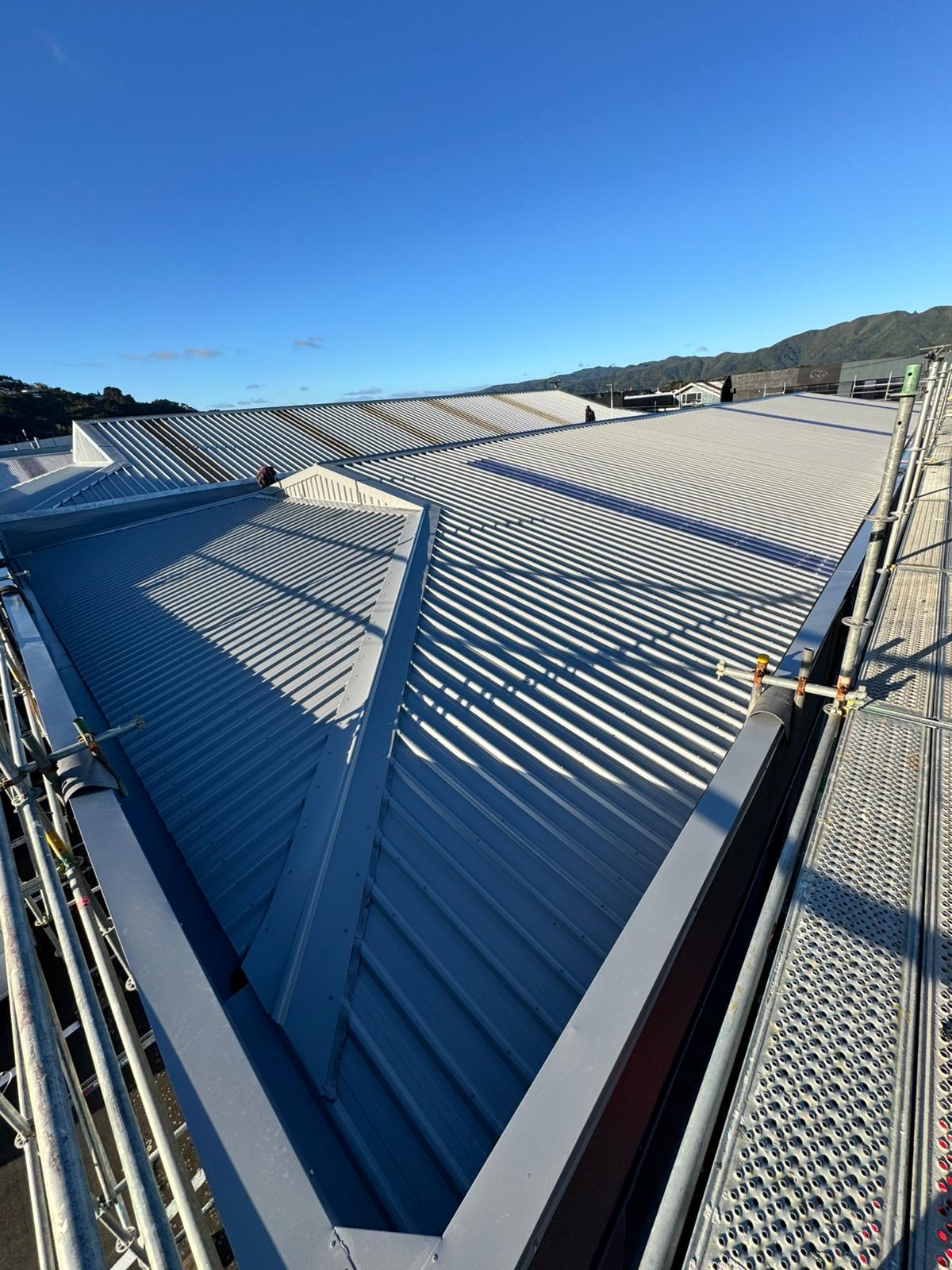
The completed photograph shows long-run metal sheets across the connected roof planes, together with the ridges, valleys and edge flashings that bring the finished roof together. The scaffolding also makes the access required for a multi-plane re-roof easy to see.
A new roof should not be judged on appearance alone. The written specification, compatible fasteners and flashings, installation details, drainage, completion information and maintenance requirements are what establish what has been supplied.
WorkSafe’s roof guidance identifies falls as the most serious roof-work hazard and says suitable protection should be used when roof cladding is replaced. The scaffolding visible in the project photographs is therefore part of understanding the real scope—not simply a background cost.
Some roof replacement work can be exempt, but the actual scope matters. MBIE’s Schedule 1 guidance gives replacement of older profiled-metal roof cladding with comparable profiled metal in the same position as an example that may be exempt, provided the conditions are met.
Structural work, a material or design change, a premature durability failure, specified systems or other project details may change the answer. All work still needs to comply with the Building Code. Confirm the proposed scope with the relevant council rather than assuming every re-roof is the same.
No. A photograph can help identify material that should be assessed, but WorkSafe says testing is the only way to confirm asbestos. Do not take the sample yourself.
That depends on whether the problem is localised or spread across the roof, the condition and safety of the sheets, the junctions and supports, and the likely cost of future maintenance. An inspection should separate a repairable defect from a roof-wide problem.
No. WorkSafe advises that suspected asbestos should not be disturbed and specifically identifies water blasting as an activity that can release fibres.
They can be planned as one connected project, but the responsibilities must be clear. Testing results, the removal scope, access, temporary protection and new-roof installation should all be accounted for.
Timing depends on roof size and complexity, testing and removal requirements, scaffolding, weather and any repairs discovered after removal. A useful quote should give a proposed sequence rather than an unsupported universal timeframe.
If you are considering an old corrugated roof replacement in Wellington, Lower Hutt, Upper Hutt, Porirua or the Kāpiti Coast, send us:
We can then discuss the sensible next step and what information is needed for a property-specific roofing scope. You can also review our metal roofing and re-roofing service or the related Wellington tile-to-metal conversion guide.
Request a roofing assessment or call 022 155 3184.